
Jefferson VINELink Release Coverage
Kansas VINELink is a custody-status and notification service populated by participating reporting agencies. It can report an agency's custody location, status, and changes for a matched person. Individual Jefferson County roster profiles include a VINELink icon, which establishes a local handoff to the statewide service. Research did not find an authoritative public roster proving that every Kansas jail and every KDOC record feeds VINE.
Coverage must be checked on the matched record. Confirm that Jefferson County Sheriff or KDOC appears as the reporting agency. If a different agency appears, the record may concern another custody event. A released result means the named reporting custody ended. It does not establish dismissal, sentence discharge, or the absence of another hold or supervision term.
The Kansas service is also not a durable historical archive. A person may be missing because of spelling, an identifier mismatch, a rolled-off record, delayed reporting, transfer, or nonparticipation. Use the result as a prompt for an agency check.
Search One Jefferson VINE Record
Start from the Kansas state page. A common name can return more than one result, so identity checks are part of the search rather than an optional final step. A booking or offender number is stronger than a name alone when the interface accepts it.
- Choose the Kansas offender or custody search and enter the full name or offered identifier.
- Compare age or date of birth, reporting agency, and location. Do not select only by name.
- Open the closest match and preserve its exact status language, event date, and agency.
- Compare a Jefferson jail event with the sheriff's released profile, or a state event with KASPER movements and status.
- Call the reporting agency when documentary confirmation is needed.
The Jefferson roster gateway separates current inmates from a rolling 48-hour release view. The current tab shows custody, not a release archive. The released profile can add an exact release timestamp, booking number, arresting agency, and the VINELink handoff. After that card expires, request the jail release sheet.
For state custody, search KASPER. Inmate means current KDOC custody. Parole or postrelease means prison exit under supervision. Discharged supports sentence completion. A new prison location with Inmate status is a transfer, not release.
Jefferson VINE Release Fields
Field names depend on the reporting agency and live interface. Preserve what the record actually says instead of translating a custody change into a broader legal conclusion.
| Field | How to read it |
|---|---|
| Name or identifier | Supports identity, but must be compared with age, date of birth, or agency data. |
| Reporting agency | Defines which custody the event concerns. |
| Custody status | States the agency-reported condition at the displayed update. |
| Facility or location | Shows the reporting location when supplied; a changed location may be transfer. |
| Event date or time | Marks the reported change, not necessarily sentence discharge. |
The sheriff's release card contains fields VINE may not preserve, including the exact local release time, booking and release timestamps, charges, bond, and booking number. It lacks the release reason, destination, receiving agency, and supervision status. Using both records fills some gaps but does not create facts that neither agency published.
View the Kansas VINELink search screen before starting a person-specific check.
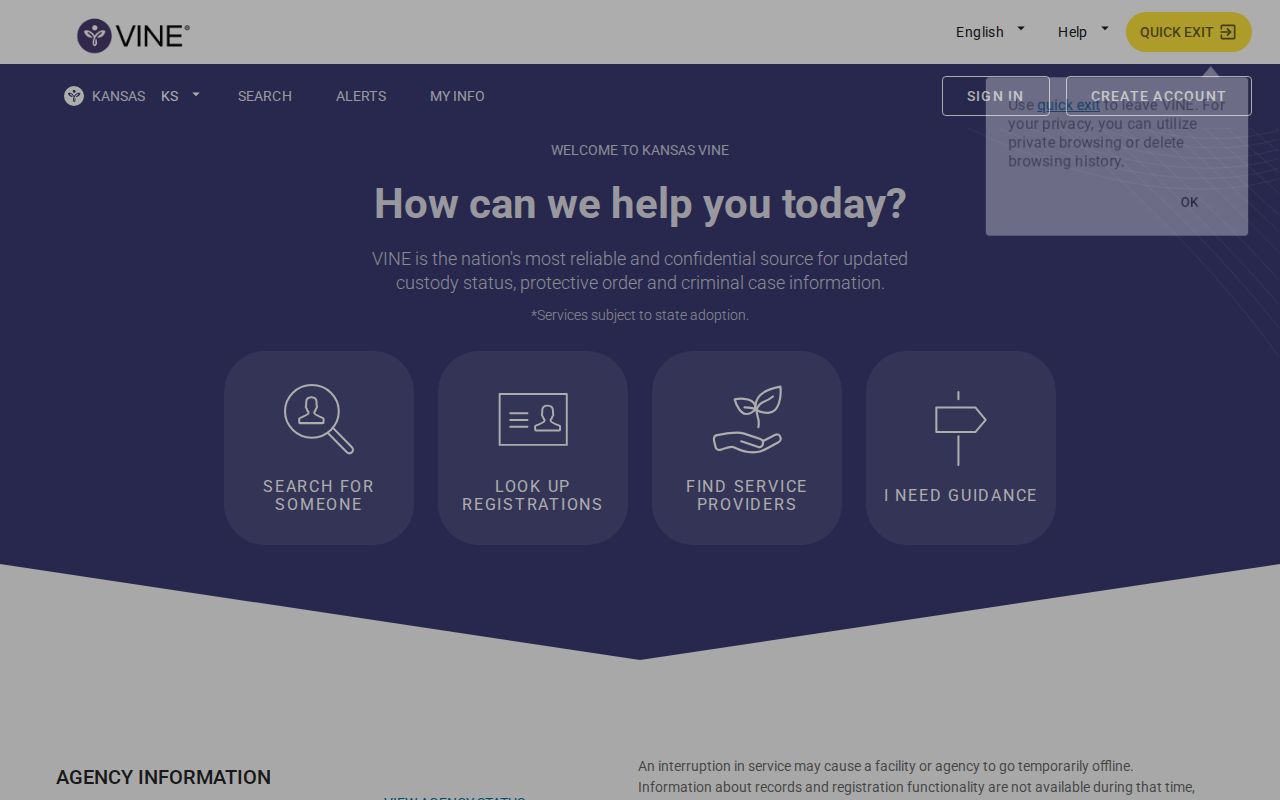
The state screen is the correct entry point, while the agency named on a later match determines how the event must be verified.
Register Jefferson Release Notifications
Register while the correct person remains searchable. The live Kansas interface controls which event types and delivery channels are offered, so read its current labels instead of assuming every method is available.
- Open the verified person and select registration or notifications.
- Choose custody status, release, transfer, or another offered event.
- Select phone, email, text, or the method shown and enter the destination carefully.
- Complete the confirmation steps. Create or enter a PIN only if the live telephone workflow requests one.
- Save the confirmation and keep any PIN private.
- When an alert arrives, compare it with the sheriff, KDOC, BOP, or ICE record for the reporting agency.
VINE help explains search and notification functions. Legacy telephone calls may use a PIN to confirm receipt and stop repeat calls. Digital methods may instead require a code or verification link. Interface details change, so do not publish or rely on an assumed PIN format.
A notification can arrive before a public agency display catches up, or the public display can change first. Save the alert time and then seek the actual release or movement record.
Confirm Jefferson VINELink Alerts
No single search covers county, state, federal, and immigration custody. For a Jefferson County jail event, compare the alert with the official 48-hour release feed and call the jail if destination or reason matters. For KDOC, use KASPER and the listed parole office. A working-day update schedule can leave weekend changes temporarily absent.
Federal cases require the BOP inmate locator. Immigration custody requires the ICE locator and the relevant ERO office. Jefferson County Jail houses some ICE detainees, so leaving the county feed can mean transfer within immigration custody rather than return to the community.
Important: VINE is not a certified archive. Verify a reported event with the sheriff, KDOC, BOP, or ICE office that created the custody record.
Jefferson Roster-to-VINE Handoff
The VINELink icon on an individual Jefferson roster profile is the strongest county-specific route into notification. Starting from that profile can reduce name ambiguity because the user has already matched a local booking. Registration before release also makes it more likely that an alert remains tied to the intended custody episode.
The handoff still requires a reporting-agency check. No public statewide participation inventory was found that proves every Jefferson or KDOC feed. After an alert, pair it with the sheriff's exact release time or the KASPER movement and status. If the agencies differ, investigate a transfer instead of merging the records.
After the sheriff card rolls out of the 48-hour window, submit a focused Jefferson County open-records request for the booking and release sheet. Name the person, booking number and date, actual release date and time, release authority or code, destination or receiving agency if recorded, and related booking photograph. The county need only provide existing, nonexempt records.
VINE, the local release feed, KASPER, court records, and a records request answer different questions. Their dates should form a traceable sequence rather than being treated as interchangeable search results.
A court record provides another check when the custody alert concerns a Jefferson case. Bond orders, dismissal entries, sentencing documents, and probation orders can explain the legal event behind a jail change. They still do not replace the jail's own release timestamp. District Court records are held by the court, not Jefferson County's administrative open-records office, even though the clerk works in the courthouse.
The Kansas registered-offender search is narrower still. It covers people required to register under Kansas law, not the general released population. A registry match can show a qualifying person in the community, but it cannot establish the exact jail or prison release date. The Jefferson sheriff warns that its local registry view is not complete, so the KBI statewide registry is the primary registry source when that separate question applies.
Match Jefferson Alerts to Custody
Jefferson County release research requires a custody-specific route. The sheriff's jail holds local detainees, people from surrounding counties, people bound for KDOC, and ICE detainees. A VINE event tied to the sheriff therefore marks the end of the local jail's custody, not a guaranteed return to the community. Ask the jail for the destination or receiving agency when the released profile does not supply it.
If KDOC appears as the reporting agency, open KASPER and compare the KDOC number, movements, current facility, anticipated release date, and supervision type. A move from one prison to another remains custody. Parole, conditional release, or postrelease means release from the secure prison with continuing conditions. Discharged is the clearest public state sentence-completion status. Deceased labels must not be described as an ordinary release.
A federal result follows another path. The BOP inmate locator can show a past federal release date and “Not in BOP custody,” but that phrase covers only BOP custody. It does not rule out state, local, immigration, USMS, or supervision obligations. VINELink should not be treated as a substitute for the BOP locator. An ICE event must be checked through the ICE locator and the relevant ERO office.
When a VINE search returns nothing, retry the exact legal name, common variations, and an offered identifier. Check whether the expected agency participates on the live result. Then move to the sheriff roster, KASPER, court portal, BOP locator, or ICE locator based on the known custody. A missing VINE record is a routing signal, not a finding that the person was never held or has been released.
Request Jefferson Release Proof
A notification is useful for timing, but an agency record is better when the precise event matters. Jefferson County's KORA request form accepts requester and contact details, a delivery choice, a precise record description, signature and date, and a noncommercial-use certification. The agency may charge permitted fees or require prepayment, apply exemptions, and redact protected material. It does not have to create a custom report.
Ask for the existing booking and release record for the named person and booking. Specify actual release date and time, release authority or code, receiving agency or destination if recorded, and the related booking number. If a VINE alert supplied an event time, include it to help identify the custody episode. For a KDOC event, route the request to the KDOC open-records portal and use the KDOC number.
Keep the original alert, confirmation, and agency response together. That set shows what VINE reported, which office supplied the underlying data, and what the official record later confirmed. It also preserves the difference between a notice of change and a certified or agency-maintained release record.
Public Record Search
Sponsored Results