
Kansas Corrections Release Paths
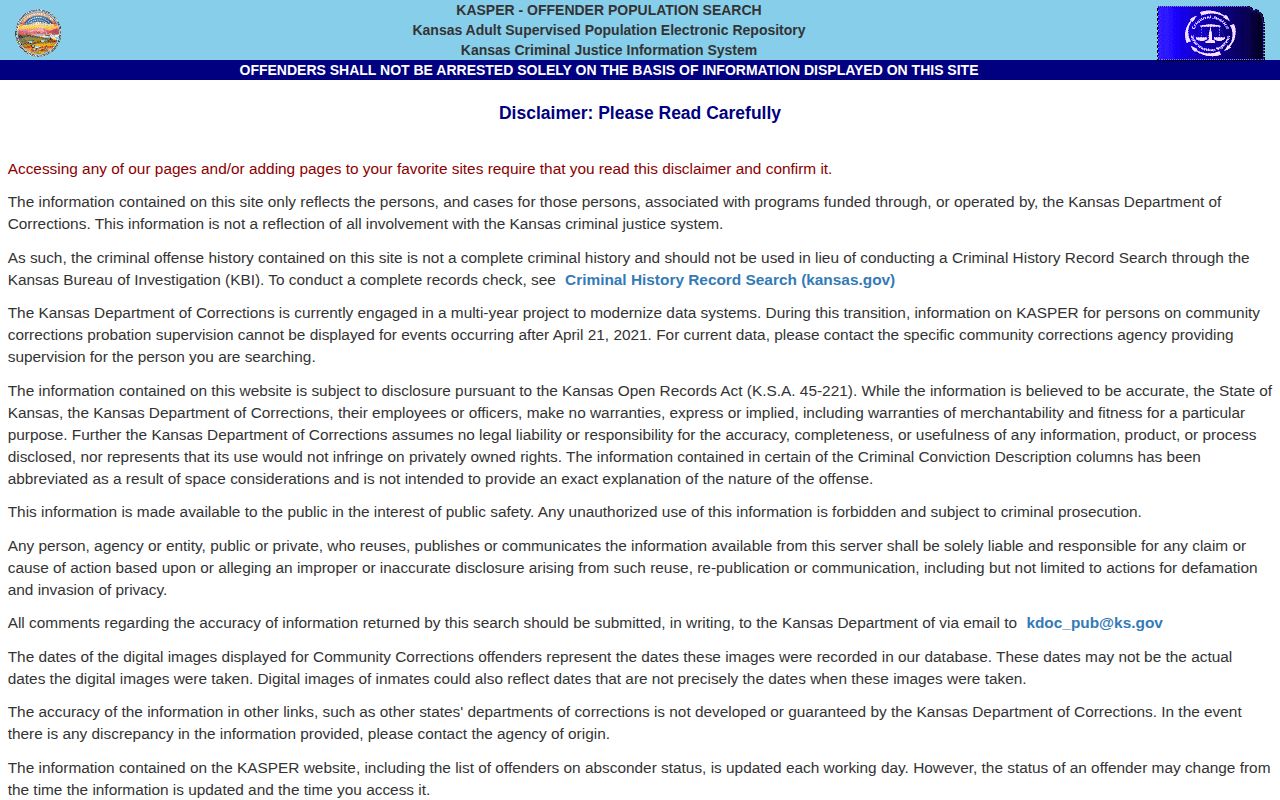
The KASPER search gateway is the statewide public route for KDOC identity, sentence, facility, movement, anticipated-date, and supervision data. It covers the KDOC population rather than every county detainee. Read movement and supervision fields together. A new prison location with Inmate status is a transfer; parole or postrelease marks prison exit under supervision; Discharged marks sentence completion.
KDOC classification controls state placement. Jefferson County of conviction does not assign one prison. The current facility and movement dates show where state custody continued, while the later supervision or discharge status shows what happened after secure confinement.
Confirm Kansas Corrections Release
Use the KASPER offender search by name or KDOC number. Compare identity, conviction, sentence, and facility fields. The anticipated release date is a calculation rather than proof of release. Confirm the later movement and supervision status. KASPER updates on working days, so a weekend change may lag.
- Check the released view and open the matching profile.
- Record the KDOC number, movement date, and release time.
- Call KDOC Sentence Computation staff when the reason or destination matters.
- Check KASPER movement history for the controlling order.
- Use KASPER, the receiving county, or ICE ODLS when transfer is possible.
- Request the KDOC release record after the online result rolls off.
Kansas Corrections Release Fields
A KASPER result may show the KDOC number, identity and physical description, photograph, convictions and county, case and sentence data, anticipated release date, current facility, movements, supervision type and level, supervising parole office, and disciplinary findings. Match several identity fields before interpreting status.
| Field | What it can establish |
|---|---|
| Booking number | The state custody event to cite in a call or request |
| Release timestamp | When the person left this correctional system |
| Bond | A displayed case figure, not proof of release reason |
| Arresting agency | Which agency initiated the booking |
| VINELink icon | A route to custody notification, subject to agency reporting |
KASPER is broad but not a certified release instrument, and its working-day update schedule can lag a weekend event. Ask KDOC for the existing record when an exact actual date or movement needs documentary confirmation. Do not ask the county to create a new narrative. The Jefferson County released-inmate search explains how local, state, court, and federal records fit together.
Kansas Corrections Records Contact
Call the correctional system for an immediate status, correct bail or charge information, case number, actual release time, transfer destination, or property procedure. Administrative hours are not jail operating hours. The detention operation continues around the clock.
714 SW Jackson Street, Suite 300
Topeka, KS 66603
785-296-3317
KASPER corrections: kdoc_pub@ks.gov
For a durable copy, use the KDOC GovQA open-records portal. KDOC Open Records is at 714 SW Jackson Street, Suite 300, Topeka, KS 66603; 785-296-3317. Ask for existing sentence, movement, actual release, supervision, discharge, and photograph fields tied to the KDOC number. Actual costs and lawful redactions can apply.
Request Kansas Discharge Records
Name the person and KDOC number. Request existing sentence, facility, movement, actual release, supervision, discharge, and offender-photograph fields. State the date range and the precise record needed. Electronic delivery can reduce delay and cost. If parts are withheld, ask for the statutory basis and for any reasonably segregable public portion.
Judicial records follow another route. Jefferson County’s open-records office warns that District Court is not a county agency even though it sits in the courthouse. Contact the Second Judicial District Court at 300 Jefferson Street, P.O. Box 327, Oskaloosa, KS 66066, or 785-863-2461 for bond orders, journal entries, dispositions, sentences, probation, revocations, or case discharge. A court order can explain why state prison custody ended, but the jail release timestamp remains the best local evidence of physical exit.
Inside Kansas Department of Corrections
KDOC operates the state prison system. Its statewide facility directory identifies institutions and contacts, while KASPER associates a person with a current location and movement history. Jefferson County is not verified to contain a KDOC prison, and nearby institutions are examples rather than default destinations.
The official facility source and custody information can be seen in the source capture below.
The image reinforces the facility’s mixed role. An individual record still needs its own release sheet, court order, or receiving-agency match.
KASPER Status Is Decisive
KASPER distinguishes a prison movement from release. Inmate with a different facility means state custody continued. Parole, postrelease, or conditional release means secure custody ended while legal supervision remains. Discharged is the clearest public sign that the KDOC sentence ended. Deceased and Discharged-Deceased must not be described as ordinary release events.
The future field is an anticipated release date, not a promise. Credits, forfeitures, court action, sentence structure, and other legal events can change it. KASPER updates on working days, so a weekend event can appear later. Confirm the actual movement and final status, then use the supervising office shown on the matched record when a person returns to Jefferson County under supervision.
After Kansas Corrections Release
Kansas sentence vocabulary matters. Most non-off-grid crimes committed under the modern guidelines lead from the prison portion to mandatory postrelease supervision, while older indeterminate and specified life or off-grid sentences may involve parole eligibility and the Prisoner Review Board. Eligibility is only permission for Board consideration. It is not an actual release date. The anticipated date, a hearing month, a Board result, and the later movement status are four separate milestones.
Good-time rules also vary by offense date and severity. K.S.A. 21-6821 permits different maximum credits for specified categories and allows certain program credits; older cases can fall under K.S.A. 22-3725. Credits may be earned, withheld, forfeited, or restored. That is why a public anticipated date can change. Sentence Computation, not a county jail, resolves the controlling state calculation.
If KASPER later shows Inmate, the person entered or remained in state prison custody. A parole or postrelease status means secure prison custody ended but state supervision continues. Discharged means the KDOC sentence ended. A court portal record may show dismissal, sentence, or bond action but can lag behind the physical exit. VINELink can provide an alert, yet the reporting agency’s record controls when data conflict.
Keep the custody systems separate. The Sheriff answers for its jail. KDOC answers for Kansas prison custody. District Court holds judicial orders. ICE answers for immigration detention, and BOP covers federal sentenced prisoners. This sequence avoids the common error of treating a blank current roster as proof that all custody and supervision ended.